
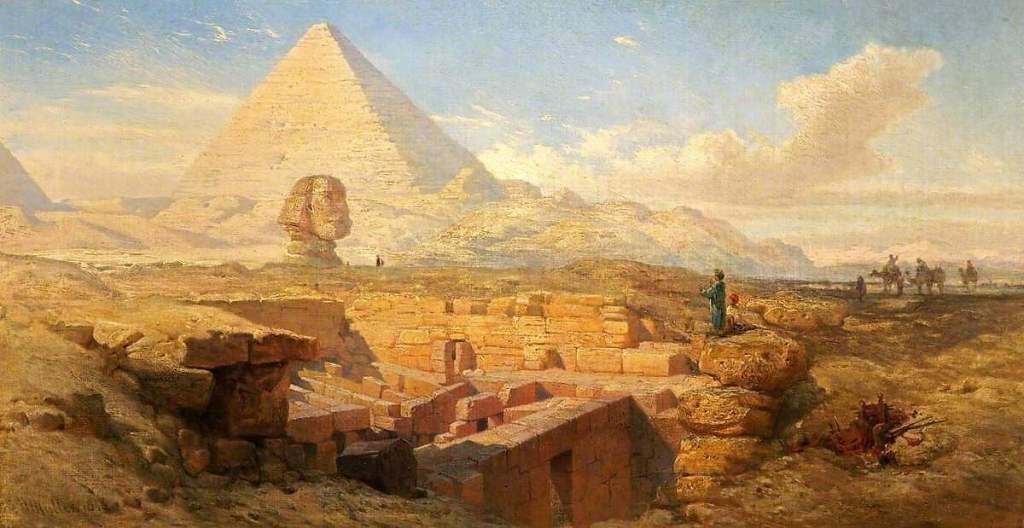
Featured image: William James Müller, The Pyramids
I was trying to clean up my cloud photo library when I stumbled upon a video of the speech I delivered during my undergrad farewell party. Said party was in April 2018. It’s been over four years since. In some ways, it feels like BCA (my undergrad program) was just yesterday, in some others, it feels like a lifetime has passed since it ended. In this lifetime, I moved to a different continent, got into a relationship, started my postgrad, experienced a completely different culture, made new friends, lost touch with some of my old friends, got my first student job, finished my postgrad and started working full time.
When she started working full time, my mother was as old as I was when I first came to Germany. 21. My parents were younger than my present age when they got married and started a major chapter of their lives. They were two years older than I am right now when they had me. 27. Times change and with them, certain parameters (e.g. the “appropriate” age to get married or to have kids at) change as well, but the general logical order of events does not. We are born, we follow and learn, we acquire and grow, then apply and grow further, then we die. The concept of ashrama might come to mind. Here is what Encyclopaedia Britannica has to say about it:
ashrama | also spelled asrama | Sanskrit āśrama
in Hinduism, any of the four stages of life through which a Hindu ideally will passThe stages are those of (1) the student (brahmacari), marked by chastity, devotion, and obedience to one’s teacher, (2) the householder (grihastha), requiring marriage, the begetting of children, sustaining one’s family and helping support priests and holy men, and fulfillment of duties toward gods and ancestors, (3) the forest dweller (vanaprastha), beginning after the birth of grandchildren and consisting of withdrawal from concern with material things, pursuit of solitude, and ascetic and yogic practices, and (4) the homeless renouncer (sannyasi), involving renouncing all one’s possessions to wander from place to place begging for food, concerned only with union with brahman (the Absolute).
Britannica, T. Editors of Encyclopaedia. “ashrama.” Encyclopedia Britannica, July 21, 2017. https://www.britannica.com/topic/ashrama.
This doesn’t have a one-to-one correspondence with the stages of life I came up with off the top of my head, but you get the idea: The logical order of events is pretty much the same.
After finishing my studies and starting my job, I went from being a modern-day brahmachari to a modern-day grihastha. I started earning real money and all. Groundbreaking stuff (for me). I can spend it as I please without anyone challenging me. This is what raw power feels like. That’s my segue into the popular adage and subsequently, the topic of this post:
With great power comes great responsibility.
Uncle Ben (and before him, someone in ancient Greece)
I am lucky enough to have led a warm, cushy life; of having been in the position to choose when to take on said responsibility. The phrasing is important… take on responsibility. I chose this for myself. I am fortunate enough to have had the option to chill for some months before starting work, but no, I had to be like Postgrad-Pune-Munich-Work. That’s on me. I didn’t want to mooch off of my parents anymore, because I was guilty about the privilege I had already had up until that point. They would have happily supported me till I started working if I had told them that I wanted to take a break for a few months before “launching into grihasthaashram.” But no, I am nothing if not obstinate.
Like most families I know, my family has had a history of sincerity and hard work. My maternal grandparents both started working straight out of college (in fact, my granddad worked and did his undergrad side by side, if I’m not mistaken). My paternal grandfather didn’t even have a university degree, but started and ran his own library with my grandmother by his side. Aai started her career with a gruelling medical rep job immediately after her B.Pharm., and Baba started his career right after his MCM. None of them had the luxury to “take a break.” This was Maslow’s hierarchy of needs at play. My grandparents climbed the rungs of the middle class to give my parents a life better than the one they had had. My parents had done the same thing for me, so that I was indeed in the position to say that I wanted to take a break and literally do nothing productive for a while before beginning to work full time. But I didn’t make use of it, all in the name of guilt, gratitude, legacy and values. For the record, I don’t regret doing this. Taking a break would have just postponed my current predicament (more on this in a bit) by some time.
My parents have made it abundantly clear that they don’t expect me to support them when they get old. They have saved and invested their money sufficiently well to secure their future even after retirement. But that doesn’t change the fact that I want to splurge on them, not out of a sense of duty, but purely because I love them. I am not going to pretend to be Shraavan baal here and claim that I am a selfless, dutiful daughter. I also want to have a good life for myself. I want to go higher on Maslow’s pyramid. Provide my future kid(s) with an even better life. That’s the nature of man.
Another reason I went straight from student to responsible adult is that I have firmly believed for some time now that jumping in at the deep end is the best way to go about things. I have been holding on to this expression as if it were a motto for life. I even had the German equivalent plastered across my laptop screen throughout my bachelor studies:
ins kalte Wasser springen | /ins kal·te Was·ser sprin·gen/ | Redewendung
umgangsprachlich: eine neue, unbekannte Situation oder Aufgabe bewähren müssen
So that’s what I did after my master studies. I jumped in at the deep end / Ich bin ins kalte Wasser gesprungen. But when you’re an inherent perfectionist, the deep end can be a dangerous place.
Lately, I’ve been feeling like Sanika-circa-2014/15. She had visions of grandeur, of becoming this intellectually-motivated Physicist. She wanted perfection. She demanded that of herself. After realizing that perfection was (near-)impossible to achieve, she let her responsibilities as a student pile up, untouched, became paralysed under their weight, and cracked. 68.308% i.e., in her dictionary, failure.
Now I find myself at a crossroads. I recognize this feeling of expecting perfection from myself. The context might have changed, but the feeling is the same. It would be stupid to let it take over me once again. To err is human, to learn something from that is sensible human. And I have been proudly prancing about as a sensible human all my life.
Getting rid of this constant desire for perfection is going to be hard, but I’m gonna have to do it if I am to get any real work done. I don’t mean “work” as in just the work I get paid to do right now. I am using it as more of an umbrella term for everything ranging from household chores to eventually running a successful business.
To stretch the deep-end metaphor a little further, it’s alright to jump in at the deep end, provided I don’t stay immobile till I start to swim like Michael Phelps. Because if I do that, I will drown. I will have to start by flapping my limbs about like a toddler barely managing to stay afloat and keep at it till I eventually get to Olympic-level swimming.[1]
Here is to prioritizing something over all-or-nothing. The road ahead is tough, it involves unlearning a mindset that has accompanied me for a large part of my life. But I gotta start by flapping my limbs about.
Footnotes:
[1]A more intuitive metaphor for the software people out there: My work should follow an agile model instead of a waterfall one.

 Sanika MN Joshi
Leave a comment